The Randall Museum in San Francisco hosts a large HO-scale model railroad. Created by the Golden Gate Model Railroad Club starting in 1961, the layout was donated to the Museum in 2015. Since then I have started automatizing trains running on the layout. I am also the model railroad maintainer. This blog describes various updates on the Randall Museum Model Railroad and I maintain a separate tech blog for all my electronics & software not directly related to Randall.
2026-01-26 - Automation Maintenance
Category RandallYet another day of “fixing whatever needs to be fixed” for the train automation and a bunch of other tiny things to take care of. The Zephyrette has been giving me trouble on the Branchline recently so I decided to replace it whilst I look at it more carefully. The Passenger UP engine decided to not have sound anymore so I also replaced it. Details below.
Mainline Passenger automation (front) and Branchline automation (back).
First, I started the day by fishing out Jim’s train derailed in Fairfield, in a location hard to reach:
Fairfield.

That was shorting the power district, which is never a good thing for the engine or for the rest of the DCC system. The picture above depicts how I found the train.
I can’t quite figure out the sequence of events that made the train separate from its cars and derail in such a way. Anyhow, forensics was not part of the day’s tasks so let’s move on. I also crawled to and examined the end of the Tehachapi loop and the Bridgeport T450 turnout as Jim indicated the train had derailed there. I could not find anything wrong with the track itself -- no debris or anything visible on the track.
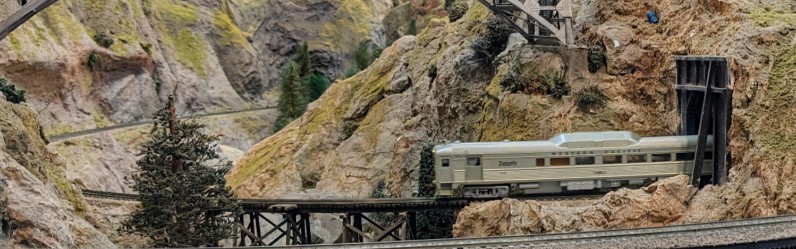
My main concern was the Zephyrette RDC that has been running on the Branchline. Last week it started behaving erratically -- stopping on very specific sections of the track. The track sensors could not detect the engine, which means it wasn’t electrically making contact. Then later -- anywhere from 20 minutes to hours -- it would re-appear on the block sensor map and be controllable.
Zephyrette RDC on the Branchline.
Testing the track, I could not find obvious conductivity issues, and even after cleaning the track carefully, the engine would stop and go on a few specific places. I suspect the issue is with the engine.
As a test, I put another engine on the Branchline, and it behaved just fine, confirming my hypothesis that the issue is with the Zephyrette itself.
I had cleaned the Zephyrette wheels a couple weeks ago and they still looked clean -- however sometimes that’s not enough. For example, for the main automation Bachmann, I also need to disassemble the trucks and clear the side contacts (the “journals”) to prevent stuttering. I figure we need something similar here.
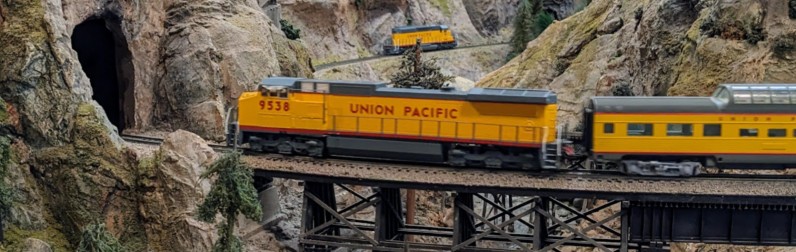
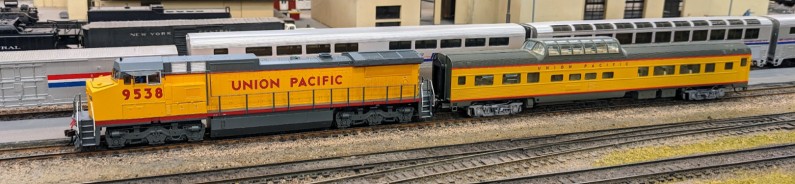
While I was checking the Branchline’s Zephyrette, I was running the UP 9538 engine for the Passenger Automation as usual to make sure it’s fine, when I realized at some point that the engine was silent -- its sound cut off instead of sounding a horn whilst going over the canyon bridge. No matter what I tried with the DCC controller, I couldn’t get the sound to turn back on. OK one more problem in the way. At least, that was easy to fix, or more exactly to work around: it turns out last year I acquired on purpose an exact replica of the UP 9538 engine, which I had already configured in JMRI to have exactly the same characteristics as the first one. Now, through the magic of buying two of them, all I had to do was replace the UP 9538 engine #1 by its clone #2, and voilà, the automation is instantly back in business whilst I will look at the first engine another day. In this case, I highly suspect that a simple decoder reset + reprogram will be enough to fix it. Modern decoders are sometimes indistinguishable from printers.
The second UP 9538 engine.
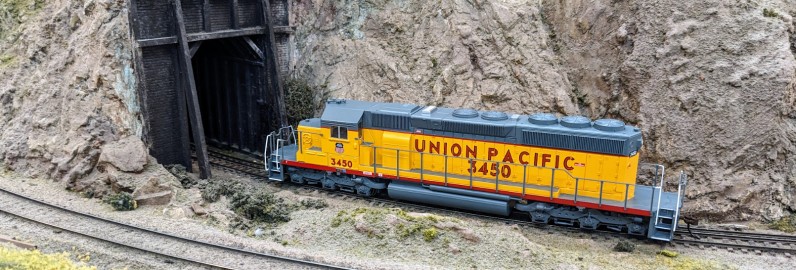
OK so now, let’s go back to that Branchline. I decided I will look at the Zephyrette another day, and in the meantime I could use that new Bachmann UP SD40-2 I got last year. A quick check revealed it worked well on the Branchline so I quickly adjusted my automation program for it:
Bachmann UP 3450 SD40-2 on the Branchline.
When I tried the new automation program, I found a couple issues. First the couplers’ hoses were getting stuck on the rails in a few places. Easy fix, I just cut them shorter. More annoying, the engine was getting stuck sometimes on the track near the garage track. Upon closer inspection, I realized there’s one of these annoying uncoupling magnets there and it was hitting the underframe of the engine. I decided the best course of action was to remove the unused magnet, and of course that one is neatly almost out of reach. Eventually I got it removed:
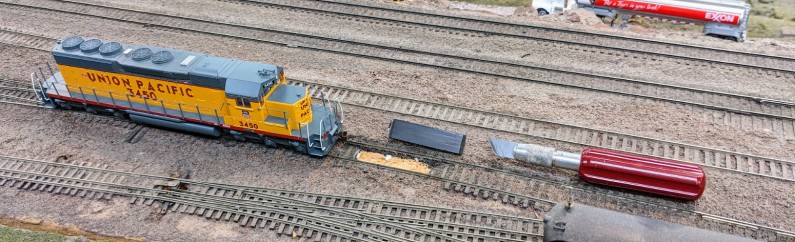
These are both glued and nailed in place. I realized after that I should have used some isopropyl alcohol to lose the glue, that would have made the task a bit easier. Anyhow, with that fix done, the engine now runs smoothly on the Branchline. As usual, I will try the engine alone first, and if all goes well, in a week or two I will try to add a freight car and maybe a caboose. Things can derail very easily on the Branchline’s sub-par track so it’s imperative to try one change at a time and not rush things.