The Randall Museum in San Francisco hosts a large HO-scale model railroad. Created by the Golden Gate Model Railroad Club starting in 1961, the layout was donated to the Museum in 2015. Since then I have started automatizing trains running on the layout. I am also the model railroad maintainer. This blog describes various updates on the Randall Museum Model Railroad and I maintain a separate tech blog for all my electronics & software not directly related to Randall.
2026-06-11 - Automation HO Engine Roster
Category RandallLast year, I started compiling a roster of all the engines used on the Randall Model Railroad automation for both the mainline and the branchline. The one for the Passenger Train on the mainline speaks for itself:
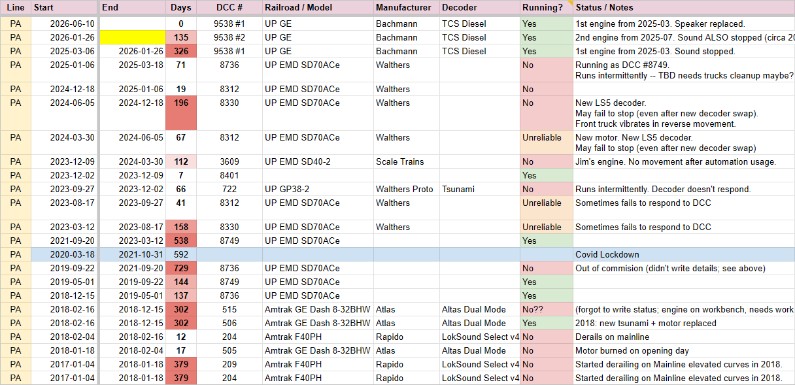
It took me a while to compile all the changes made since 2017. A good part of it was based on an older spreadsheet I had, and I also was able to pull quite some data from all the automation changes carefully recorded in the git repository of the Conductor project.
What matters is that “Running?” column… The name says it all. It records the status of the engine when I stopped running in automation. That’s a lot of red ☹️ The goal would be ideally to swap engines before they become non-functional, and clearly that’s not happening frequently.
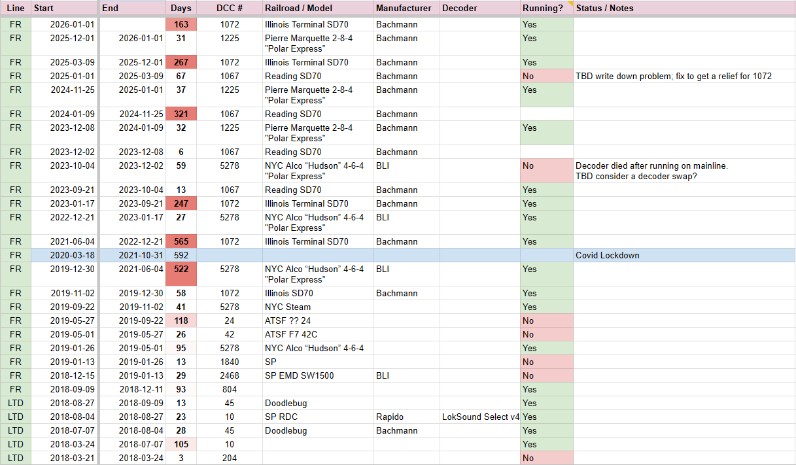
The freight route on the mainline fares a bit better:
and the branchline is another messy situation:
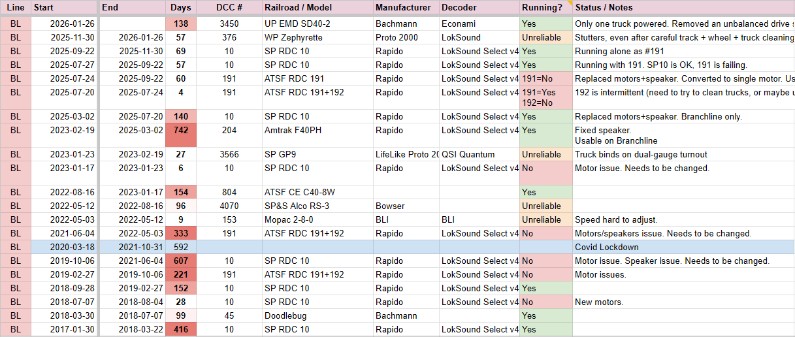
Now, the “Days” column is fairly simple: my original goal was to rotate the automation engines about every 3 months, so anything above 90 days highlights in red. But then, when an engine works and I don’t have a replacement at all… well it turns out that policy doesn’t quite work at all. Thus that unrealistic policy quickly turned into “if it ain’t broke, don’t fix it”. I’m all about pragmatism (a.k.a. “lowest effort”) after all. <sarcasm>
Anyhow, the freight train runs a much shorter route, and it’s sort of flat. No big elevation changes. That helps a lot. The mainline going to Summit has a long ramp going up, and the route is 3 times longer. That longer route is more taxing for the engines.
The branchline is also a fairly flat route, and not much longer than the freight route, yet it’s been a constant source of nuisance.
When an engine fails, I try to fix it as much as I can. Yet there’s only so much I can do. If it’s as simple as cleaning trucks and electrical pickups, fine. I can also swap motors or decoders when I can get replacements. Sometimes engines just end up being entirely unreliable and I can’t quite figure out why. What I don’t do is randomly swap components that I don’t know if they are truly defective, especially when I don’t have alternates in the first place. That’s just not a cost effective way to deal with this. I try to operate on facts, not guesses.
I feel like one could easily draw conclusions by OEMs here, but that’s not quite true. BLI engines generally have a lot of issues with the DCC on our old layout, and I’m guessing this has to do with cross electrical district spikes (meaning I blame the layout, not the BLI decoders per se). Bachmann engines have proven to be entirely hit or miss. They either tend to fail right away or work flawlessly for a long time. Same goes for Walthers’ engines. Rapido engines are amongst the nicest ones to automate (feature wise) yet they tend to not last long for one reason or another; however they have exceptional support and I got replacement motors or speakers from Rapido when I needed them. Eventually, all OEMs have their pros and cons, there’s no clear winner or loser here. I’m not picky: if it runs, I’ll take it. What I won’t do is take personal engines offered by the fellow Saturday operators on the layout -- if there’s one constant here, it is that running these engines on automation 7 hours a day for 5 days per week just simply kills them all, eventually.