The Randall Museum in San Francisco hosts a large HO-scale model railroad. Created by the Golden Gate Model Railroad Club starting in 1961, the layout was donated to the Museum in 2015. Since then I have started automatizing trains running on the layout. I am also the model railroad maintainer. This blog describes various updates on the Randall Museum Model Railroad and I maintain a separate tech blog for all my electronics & software not directly related to Randall.
2026-06-14 - Bachmann UP #9538 Speaker, Continued
Category RandallA few days ago I fixed the speaker on one of the Backmann UP #9538 engines. We run 2 of these in alternance for the passenger automation, and the speaker on the second had also failed. It’s time to swap that speaker too.
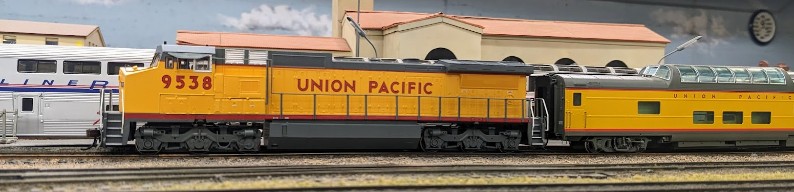
Interestingly, there are a couple minor differences between the two otherwise-identical engines. In these engines, the speaker is located inside the fuel tank, and it can be opened directly from the bottom without removing the entire shell. However, as I wrote in the previous post, last time I had to remove the shell anyway because the speaker wires were too short -- they were tucked inside the shell. Here, there’s just enough slack in the speaker wires that the fuel tank can be opened without removing the entire shell:
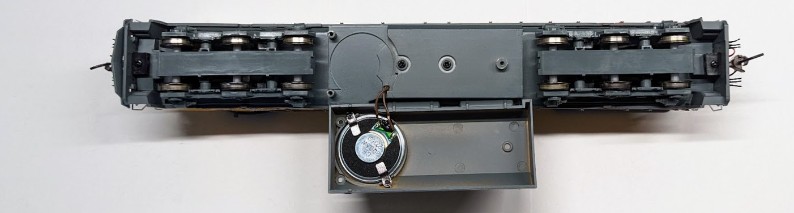
Once opened, I can see the speaker is actually slightly different. This time we have an 8 ohm speaker rated at 0.5 W instead of 0.4 W. The shape is the same. The speaker is attached to the fuel tank using these little tabs, and ironically there’s 3 of them this time, as 2 were stacked on top of each other. I like this kind of subtle difference.
Time to change that speaker.
Last time, I used the 8-ohms 2 Watt speakers from https://amzn.to/4vxHnpg; they ended up sounding very nice, even though I disliked the crude packaging that just had the 8 speakers thrown together in a plastic bag, each one sticking to the others’ magnets. This time I’m using an 8-ohm 1 Watt speaker from https://amzn.to/3PVyc2Z. The packaging is better as we have a little foam container that securely holds each speaker. The size and shape matches perfectly the speaker I’m replacing:
The original Bachmann speaker on the left; the replacement speaker on the right.
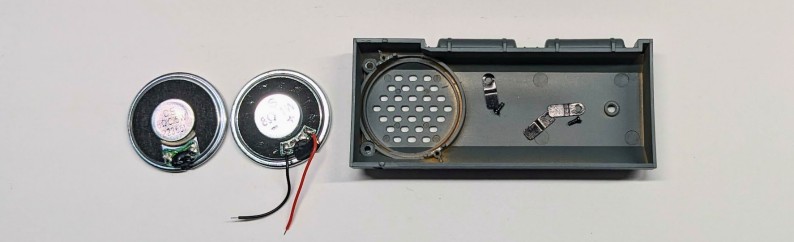
They come with a little 3 cm wire already soldered. I’ll keep that as it’s convenient to extend the short wires out of the engine:
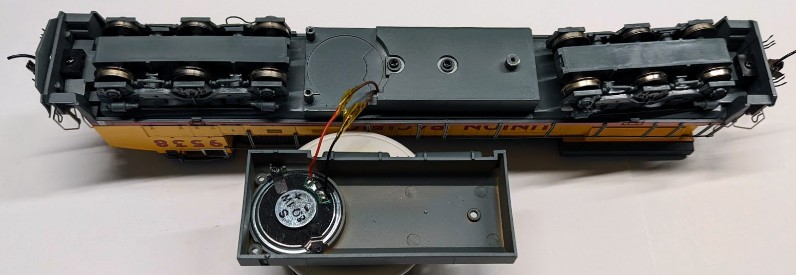
That all fits neatly inside, and it’s such an easy swap. I used polyimide tape instead of shrinking tubes for insulation as I think it’s more flexible and takes less space.
Finally, I got to run both engines side by side at Randall, and the difference between both speakers is quite drastic:
- Original speaker: 8-ohm, 0.4 W or 0.5 W
- Nice sound, a bit on the low volume side.
- Master Volume CV: 70%, the default value that came programmed in the engine.
- Engine #1 with 8-ohm 2 Watt speaker (https://amzn.to/4vxHnpg):
- Very good sound, albeit a tad on the low volume side.
- However, since we changed from a 0.4 W to a 2 W speaker, I can boost the volume without risking burning out the speaker. I’ve tried upping the master volume and there was no distortion, so I went for it.
- Master Volume CV: changed to 100%.
- Engine #2 with 8-ohm 1 Watt speaker (https://amzn.to/3PVyc2Z)
- Fairly metallic and aggressive sound. Very loud but also very harsh.
- I’ve tried variations on the master volume, and ended up lowering it. It still sounds aggressive. I don’t think this speaker has a nice frequency response. On a Soundtraxx decoder, I’d try to change the equalizer to better match a small speaker, but that’s unfortunately not an option on the TCS decoder.
- Master Volume CV: changed to 50%.
Overall I much prefer the sound of the 2 Watt speaker, even though I had to max the Master Volume and the packaging is very crude. That said, I don’t think most people will be able to tell the difference since both engines will never run at the same time. Since the new speakers have a much higher power rating, they should last longer. And if they don’t, I have replacements at hand, and I can refer to these posts to remember how to replace them later (why else do you think I spend so much effort documenting how to open these HO engines in these posts, duh!? I document these things thoroughly because I’m lazy and I don’t want to have to figure it out twice!)